How Dr. Jeffrey S. Mader Uses Advanced Techniques to Rebuild a Rock-Solid Foundation
Introduction: The Common Fear Holding Back Michiana Patients
If you have been living with missing teeth or wearing traditional dentures for years, you may feel self-conscious about a gap in your smile, or struggle with the daily hassle of loose prosthetics. Perhaps you’ve considered a permanent solution, only to be discouraged by a common fear: “I don’t think I have enough bone left.”
At Michiana Dental Implants, we understand this concern. While it is true that a secure dental implant requires a certain amount of jawbone density for stability, Dr. Jeffrey S. Mader specializes in innovative techniques that restore candidacy for patients previously told “no.” Having bone loss does not automatically disqualify you from achieving the permanent, functional smile you deserve.
The Science: Why Tooth Loss Leads to Bone Loss
The critical link between teeth and your jawbone is stimulation. Your natural tooth roots are anchored in the bone, and every time you chew, they transmit forces that signal the body to keep that bone dense and strong.
When a tooth is lost, that stimulation ceases. The body, efficient as it is, begins to reabsorb the unused bone tissue. According to studies published by the American Academy of Implant Dentistry (AAID), a significant percentage of jawbone width can be lost within the first year following a tooth extraction. This process is called bone resorption.
For denture wearers, this problem is compounded. Because dentures only sit on top of the gums, they offer no stimulation to the underlying bone. In fact, the constant pressure from the denture can sometimes accelerate the reabsorption process, leading to a progressively “thinner” jaw.
The Critical Visual Comparison
Understanding the difference between how dentures and implants interact with your jawbone is key to making an informed decision.
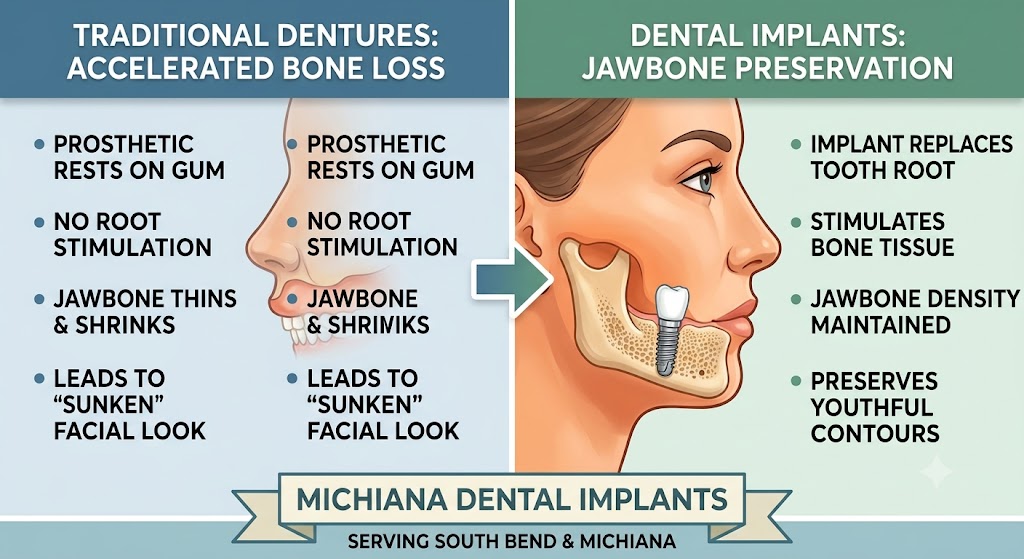
What This Graphic Shows: illustrates the crucial structural difference:
- Traditional Dentures (Left): Without root stimulation, the bone shrinks. This “thinning” of the jaw is what often causes dentures to become loose over time, requiring messy adhesives and frequent relines. It is also the underlying cause of the “sunken” facial appearance.
- Dental Implants (Right): The implant post serves as a replacement root. This stabilizes the surrounding bone and encourages the maintenance of natural facial contours and a youthful profile.
How We Make Implants Possible: Solutions for Bone Loss
If Dr. Mader determines you have insufficient bone for standard implant placement, he may recommend advanced procedures designed to rebuild your foundation:
1. Modern Bone Grafting – This is the most common solution. We place biocompatible grafting material into the areas of low density. Over a few months, your body naturally uses this scaffold to grow new, strong bone tissue, essentially creating the “rock-solid” base needed for the dental implant procedure.
2. State-of-the-Art Sinus Lifts – When replacing upper back teeth, bone loss often means the sinus cavity is too close to where the implant needs to go. A sinus lift safely raises the sinus floor and adds grafting material, creating a sufficient depth for a secure implant.
3. Angled Implant Techniques (e.g., All-on-4 or Hybridge) – In complex cases, Dr. Mader can strategically place four or more implants in a single arch, often using existing bone density by angling the posts. For some candidates, this approach can minimize or even eliminate the need for extensive bone grafting.
Schedule Your Michiana Candidacy Consultation
Don’t let the fear of bone loss keep you from exploring a permanent upgrade. Our high-tech diagnostic tools, including Cone Beam CT (3D) Scans, allow Dr. Mader to evaluate your bone density with incredible precision.
You deserve a smile that is stable, healthy, and natural-feeling. Contact the experts at Michiana Dental Implants today to take the first step.